
Unveiling Uganda’s Premier Wildlife Sanctuary: Tree-Climbing Lions, Chimpanzee Tracking, River Cruises, Volcanic Crater Lakes, and Expert Travel Strategies
1. Introduction: Why Queen Elizabeth National Park is Uganda’s Crown Jewel
Sprawling majestically across the rift valley floor in southwestern Uganda, Queen Elizabeth National Park (QENP) stands as an unrivaled titan of East African biodiversity. Covering approximately 1,978 square kilometers (764 square miles), this legendary conservation area stretches seamlessly from the jagged, snow-capped foothills of the Rwenzori Mountains to the pristine, shimmering waters of Lake Edward and Lake George. Globally celebrated for its astonishing variety of habitats, Queen Elizabeth National Park encompasses open savanna woodlands, humid equatorial rainforests, sprawling papyrus wetlands, and dramatic, ancient volcanic crater fields. For international travelers seeking an authentic, action-packed Uganda safari, Queen Elizabeth National Park represents the undisputed crown jewel of East Africa’s wilderness.
Originally established in 1952 as Kazinga National Park, the reserve was officially renamed two years later to commemorate the historic royal visit of Queen Elizabeth II. Over the past seven decades, it has blossomed into Uganda’s most popular and visited national park, drawing wildlife enthusiasts, world-class birdwatchers, professional nature photographers, and adventurous families from across the globe. What truly sets Queen Elizabeth National Park apart from other East African safari destinations is its sheer ecological variety, packed into an accessible and scenic geographical footprint. Within a single day, visitors can transition from tracking rare tree-climbing lions across sun-drenched savanna plains to cruising alongside massive hippo pods on a natural freshwater channel, and delving into a subterranean jungle canyon to observe wild chimpanzees.
Whether you are planning an exclusive luxury safari, an immersive overland adventure, or a specialized birding expedition, Queen Elizabeth National Park delivers an extraordinary encounter with wild Africa. Home to over 95 recorded mammal species and an unbelievable 600+ avian species—one of the highest bird counts for any protected park on the African continent—this sanctuary represents the perfect intersection of classic savanna game viewing and dense tropical rainforest exploration.
QUICK FACTS: QUEEN ELIZABETH NATIONAL PARK AT A GLANCE • Location: Southwestern Uganda (Spanning Kasese, Kamwenge, Rubirizi, and Rukungiri districts) • Total Surface Area: 1,978 square kilometers (764 square miles) • Year Established: 1952 (Originally Kazinga National Park; renamed in 1954 for Queen Elizabeth II) • Key Highlights: Ishasha Tree-Climbing Lions, Kazinga Channel Boat Cruise, Kyambura Gorge Chimpanzees, Kasenyi Plains, Katwe Salt Lake • Bird Species: 600+ recorded species (Ranked among Africa’s premier birding hotspots) • Mammal Species: 95+ species including African elephants, lions, leopards, Cape buffalos, and hippopotamuses • Optimal Safari Months: December to February and June to September (Peak Dry Seasons) |
2. Geographical Marvels and Diverse Ecosystems
The incredible wildlife density and ecological variety of Queen Elizabeth National Park are directly rooted in its unique geological setting. Nestled within the Western Arm of the Great Rift Valley (the Albertine Rift), the park acts as a natural crucible where diverse ecological zones converge. Extreme altitude variations, subterranean aquatic networks, and dynamic microclimates allow vastly different floral and faunal communities to thrive side by side.
The Kasenyi and Ishasha Savanna Grasslands
Dominating both the northern and southern reaches of the park, sprawling open savanna grasslands punctuated by acacia thickets, candelabra euphorbia cacti, and tall elephant grass form the foundation for classical game viewing. The Kasenyi Plains in the northeast and the Ishasha Flats in the far south serve as primary grazing zones for tens of thousands of Uganda kob, waterbucks, bushbucks, and giant Cape buffalos. These massive ungulate concentrations in turn support flourishing populations of apex predators, including lions, leopards, and spotted hyenas.
The Kazinga Channel Freshwater Ecosystem
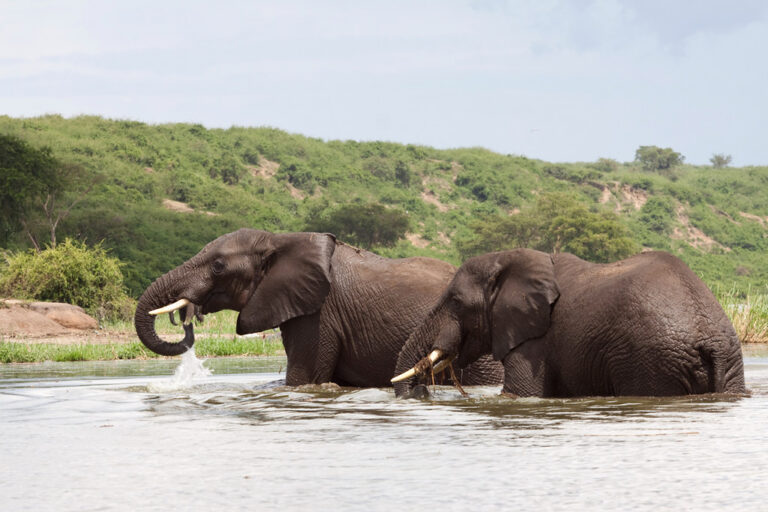
Bisecting the heart of the reserve, the famous Kazinga Channel is a natural 32-kilometer-long freshwater conduit connecting Lake George in the east to Lake Edward in the west. Acting as the park’s primary hydrological lifeline, the channel flows at a gentle, steady pace through lush riparian greenery. The nutrient-dense water sustains one of the highest concentrations of hippopotamuses on earth, along with huge Nile crocodiles, elephant herds coming down to bathe, and countless resident and migratory waterbirds.
Kyambura Gorge: The ‘Valley of Apes’
Carved deep into the flat savanna landscape in the eastern corner of the park lies Kyambura Gorge—a dramatic, 100-meter-deep subterranean tropical forest canyon often called the ‘Valley of Apes’ or the ‘Lost Valley’. Carved out over millennia by the rushing waters of the Kyambura River, this dark, lush jungle oasis provides an isolated sanctuary for a fully habituated troop of wild chimpanzees, olive baboons, black-and-white colobus monkeys, and red-tailed monkeys, offering a breathtaking contrast to the surrounding savanna.
The Katwe-Kikorongo Explosion Crater Fields
In the northern high-altitude sectors of Queen Elizabeth National Park, ancient volcanic activity has pockmarked the landscape with dozens of extinct explosion craters. The Katwe-Kikorongo and Bunyaruguru crater fields display spectacular panoramic vistas, emerald-green saline lakes, and deep crater basins. Lake Katwe, located inside one of these craters, has served as a center for traditional community salt mining since the 16th century, introducing a captivating cultural dimension to the park’s natural grandeur.
Maramagambo Forest: Tropical Canopy and Bat Caves
Stretching across the southern borders of the park, Maramagambo Forest represents one of the largest remaining natural tropical hardwood forests in Uganda. Characterized by dense ironwood tree canopies, forest streams, and hidden crater lakes, Maramagambo is a haven for forest primates, rare pythons, forest elephants, and endemic forest birds. The famous Maramagambo Bat Cave houses hundreds of thousands of Egyptian fruit bats, which attract enormous African rock pythons that prey upon them.
3. Iconic Wildlife Encounters: Big Game and Tree-Climbing Lions
A Queen Elizabeth National Park safari delivers intimate, high-impact encounters with Africa’s most iconic wild animals. Because the reserve seamlessly merges savanna grasslands, freshwater river systems, and dense tropical forests, safari-goers enjoy a well-rounded game viewing experience that stands out across East Africa.
The World-Famous Tree-Climbing Lions of Ishasha
Among all wildlife spectacles in East Africa, observing a wild lion resting casually high up in the horizontal branches of a massive fig tree is one of the rarest and most thrilling sights. In the remote southern sector of Queen Elizabeth National Park known as Ishasha, lions have evolved a distinct behavioral phenomenon: tree climbing.
While individual lions in other African reserves occasionally climb trees, Ishasha is recognized globally as the most consistent place to witness this behavior on a daily basis. Wildlife biologists attribute this unusual behavior to several environmental triggers. First, ascending high into the branches allows lions to escape the intense equatorial heat on the ground, benefiting from cool afternoon breezes. Second, it provides relief from relentless swarms of biting tsetse flies that thrive in the lower grass. Finally, elevated perches give lions an unobstructed, 360-degree vantage point to monitor grazing herds of Uganda kob and topi across the plains. Safari drives in Ishasha focus on scanning the broad limbs of ancient sycamore fig and acacia trees, rewarding persistent travelers with breathtaking photos of entire prides lounging high above the earth.
The Big Four and Abundant Savanna Herbivores
Queen Elizabeth National Park is home to four of Africa’s famous ‘Big Five’ game animals—elephants, lions, leopards, and Cape buffalos (rhinos are absent). The park supports a booming population of roughly 3,000 African bush elephants that move freely between the savanna plains, river channels, and forest edges. Heavy herds of Cape buffalo—often numbering hundreds of individuals—frequently gather along the muddy shores of the Kazinga Channel.
The primary food source for the park’s carnivores is the Uganda kob, a sleek antelope species that utilizes specific mating arenas known as ‘leks’ across the Kasenyi Plains. Other common antelopes include the waterbuck, bushbuck, giant forest hog, topi (found mainly in Ishasha), and the secretive sitatunga antelope hidden deep within southern papyrus swamps. Leopards are abundant throughout the Mweya and Kasenyi sectors, best spotted during early morning game drives or specialized nocturnal tracking safaris accompanied by armed rangers.
4. Top Safari Activities & Experiences in Queen Elizabeth National Park
To get the absolute most out of a visit to Queen Elizabeth National Park, travelers should blend game drives, water safaris, primate tracking, and cultural excursions. Below are the definitive high-conversion safari activities to include in your customized travel plan:
1. Kasenyi Plains Morning & Night Game Drives
The Kasenyi Plains, located in the northeastern sector of the park, serve as the primary stage for classic morning game drives. Guided by professional driver-guides, open-top safari vehicles navigate a network of tracks to spot lions, leopards, hyenas, elephants, and kob herds. Night game drives, conducted under permit with powerful spotlight searchlights, reveal active nocturnal hunters such as serval cats, civets, genets, nightjars, and prowling leopards.
2. Experiential Lion Tracking Research
For guests seeking an exclusive, hands-on conservation experience, the Uganda Carnivore Program (UCP) offers Experiential Lion Tracking in the Kasenyi region. Accompanied by senior researchers equipped with radio telemetry equipment, guests track collared lion prides off the main roads, collecting valuable behavioral, territorial, and health data while enjoying unprecedented close-up views.
3. The Kazinga Channel Boat Cruise
Operating daily from the Mweya Peninsula jetty, the two-hour Kazinga Channel boat launch is an absolute highlight of any Uganda safari. Modern double-decker viewing boats glide within a few meters of massive hippopotamus colonies, basking Nile crocodiles, bathing elephant herds, and hundreds of vibrant waterbirds, giving wildlife photographers a stable, eye-level vantage point.
4. Chimpanzee Trekking in Kyambura Gorge
Known as the ‘Valley of Apes,’ Kyambura Gorge offers an exciting primate trek deep within a subterranean rainforest canyon. Guided by expert Uganda Wildlife Authority (UWA) rangers, trekkers descend steep canyon walls to follow the pant-hoots and calls of wild chimpanzees as they forage, play, and groom in the canopy.
5. Ishasha Sector Tree-Climbing Lion Safaris
Situated roughly 2.5 hours south of Mweya, the Ishasha sector offers a tranquil, wilderness-focused safari environment. Game drives here navigate scenic circuits lined with sprawling sycamore fig trees, where travelers can spot tree-dwelling lion prides alongside large herds of topi antelopes and elephants.
6. Katwe Salt Lake & Explosion Crater Drives
Discover local heritage with a guided tour of the Katwe Salt Lake, where local workers employ traditional evaporation methods to harvest mineral salt. Combine this cultural visit with the dramatic 27-kilometer Explosion Crater Drive, which twists along high crater rims offering panoramic views of the Rwenzori Mountains and emerald crater lakes.
7. Maramagambo Forest Guided Nature Walks & Bat Cave
Lace up your hiking boots for a guided walking safari through the shaded paths of Maramagambo Forest. Professional guides lead visitors to a secure viewing platform overlooking the famous Bat Cave, where thousands of fruit bats roost alongside hunting African rock pythons.
5. A World-Class Birdwatching Paradise: 600+ Avian Species
Ornithologists and birding enthusiasts consistently rate Queen Elizabeth National Park as one of the elite birding destinations in Africa. The staggering concentration of over 600 bird species is made possible by the park’s unique location where East African savanna meets Central African rainforest and Albertine Rift wetland ecosystems.
Key birding zones within the reserve include the shores of the Kazinga Channel, the papyrus swamps of Katunguru, the dense canopies of Maramagambo Forest, and the Ishasha River marshes. During peak birding seasons, expert guides can help guests spot well over 100 species in a single day.
MUST-SEE BIRD SPECIES IN QUEEN ELIZABETH NATIONAL PARK • Rare & Iconic: Shoebill Stork (Balaeniceps rex) – occasionally sighted along Lake Edward marshlands • Water & Wetland Specialists: African Skimmer, Pink-backed Pelican, Saddle-billed Stork, African Fish Eagle, Malachite Kingfisher • Forest & Woodland Highlights: African Broadbill, Black-bee Eater, Blue-breasted Kingfisher, Yellow-throated Cuckoo, Great Blue Turaco • Albertine Rift Endemics: Chapin’s Flycatcher, White-tailed Lark, Verreaux’s Eagle Owl, Papyrus Gonolek, Black-rumped Buttonquail |
6. Expertly Crafted Safari Itineraries
To ensure seamless travel flow, optimal game viewing, and balanced driving times, experienced safari planners structure Queen Elizabeth National Park tours into well-paced multi-day itineraries. Below are three popular travel packages optimized for different trip lengths:
3-Day Express Queen Elizabeth Safari
- Day 1: Drive from Kampala or Entebbe via the Equator landmark at Kayabwe. Arrive at QENP in the late afternoon, check in to your lodge, and head out for an introductory sunset game drive across the Kasenyi Plains.
• Day 2: Early morning Experiential Lion Tracking or Kasenyi game drive. Enjoy a relaxing lunch at the lodge. Afternoon 2-hour Kazinga Channel boat cruise followed by an evening Explosion Crater drive.
• Day 3: Morning chimpanzee tracking in Kyambura Gorge. Midday departure back to Kampala or transfer south to Bwindi Impenetrable National Park for gorilla trekking.
5-Day Complete Queen Elizabeth & Ishasha Wilderness Tour
- Day 1: Depart Entebbe/Kampala for QENP. Evening relaxation overlooking the Kazinga Channel.
• Day 2: Early morning game drive in Kasenyi Plains. Afternoon Kazinga Channel boat launch. Night game drive focusing on nocturnal carnivores.
• Day 3: Morning Kyambura Gorge chimpanzee trekking. Afternoon guided nature walk in Maramagambo Forest to view the Bat Cave. Transfer south to the Ishasha Sector.
• Day 4: Full day spent searching for tree-climbing lions in Ishasha, birding along the Ishasha River, and enjoying sunset photography across the plains.
• Day 5: Morning game drive in Ishasha, check-out, and return journey to Kampala or Entebbe Airport.
7-Day Grand Western Uganda Circuit (Gorillas, Chimps & Wildlife)
- Day 1: Transfer from Entebbe to Kibale Forest National Park for chimpanzee trekking.
• Day 2: Chimp tracking in Kibale Forest; afternoon transfer to Queen Elizabeth National Park.
• Day 3: Morning Kasenyi Plains game drive; afternoon Kazinga Channel boat cruise.
• Day 4: Morning Explosion Crater Drive; scenic road transfer through Ishasha to spot tree-climbing lions.
• Day 5: Transfer to Bwindi Impenetrable National Park; afternoon community cultural visit.
• Day 6: Unforgettable Mountain Gorilla Trekking in Bwindi Forest; evening relaxation at Lake Bunyonyi.
• Day 7: Scenic morning drive back to Kampala/Entebbe with an Equator photo stop.
7. Planning Your Trip: Weather, Logistics, Packing & Lodging
Best Time to Visit Queen Elizabeth National Park
Queen Elizabeth National Park offers excellent wildlife viewing year-round, thanks to its position on the equator. However, weather patterns dictate seasonal highlights:
- Dry Seasons (December to February & June to September): Considered the absolute best time for game drives and primate trekking. Vegetation is sparse, improving line-of-sight visibility, and animals gather in large numbers along permanent water sources like the Kazinga Channel. Road conditions on dirt tracks are firm and easy to navigate.
• Wet / Green Seasons (March to May & October to November): Exceptional for birdwatchers due to the arrival of migratory birds from Europe and Northern Africa. The landscapes turn vibrant green, offering stunning backdrops for photography. Many luxury lodges offer discounted low-season promotional rates, though some remote tracks in Ishasha require robust 4×4 vehicles.
How to Get There: Transportation Options
- By Road: Driving from Entebbe or Kampala takes approximately 6 to 7 hours (approx. 400 km). The standard asphalt route passes through Mbarara and Bushenyi, entering the park at Katunguru. A scenic alternative goes via Fort Portal, leading travelers through lush tea estates with stunning views of the Rwenzori Mountains.
• By Air: Scheduled domestic flights operated by AeroLink Uganda or Bar Aviation depart Entebbe International Airport daily, landing at nearby airstrips including Kasese Airstrip, Mweya Airstrip, or Kihihi Airstrip (for Ishasha). Flying time is approximately 1 hour and 15 minutes.
Where to Stay: Premier Lodging Options
Queen Elizabeth National Park boasts a diverse array of accommodations catering to every budget and travel style:
- Luxury: Kyambura Gorge Lodge, Mweya Safari Lodge, Elephant Plains Lodge, Ishasha Wilderness Camp, Katara Lodge.
• Mid-Range: Queen Elizabeth Bush Lodge, Enganzi Game Lodge, Kasenyi Safari Camp, Parkview Safari Lodge.
• Budget: Simba Safari Camp, Kazinga Channel View Resort, Pumba Safari Cottages, UWA Bandas at Mweya.
Essential Packing List for a Queen Elizabeth Safari
- Clothing: Neutral, earth-toned clothing (khaki, olive, tan); light long-sleeved shirts and trousers for insect protection; comfortable hiking boots for trekking; a light fleece jacket for cool early morning game drives.
• Gear & Electronics: High-quality binoculars (8×42 or 10×42 recommended); camera with a telephoto lens (300mm+ for wildlife); extra memory cards and batteries; high-SPF sunscreen; wide-brimmed sun hat; insect repellent containing DEET.
• Documents & Health: Passport valid for at least 6 months; Yellow Fever vaccination certificate; Uganda Tourist Visa (e-Visa); personal prescription medications and malaria prophylaxis.
8. Conservation Efforts & Community Coexistence
Maintaining the natural integrity of Queen Elizabeth National Park requires continuous conservation innovation and strong partnership with local communities. Unlike many isolated African parks, QENP features eleven human sanctuary enclaves within its borders, including traditional fishing villages like Katwe, Kasenyi, and Hamukungu. This close proximity makes human-wildlife co-existence a primary management priority.
Organizations like the Uganda Wildlife Authority (UWA) and the Uganda Carnivore Program work hand-in-hand with local residents to minimize human-wildlife conflict. Solutions include constructing bee-hive fences along park boundaries—which naturally deter elephants from raiding community crops—and employing radio-tracking collars on lion prides to alert livestock herders when predators approach human settlements. Furthermore, under Ugandan law, 20% of all park entrance fees are directly reinvested into local community development projects, funding clean water infrastructure, schools, and medical clinics.
9. Conclusion: Book Your Dream Uganda Safari Today
From the iconic tree-climbing lions resting in the giant fig trees of Ishasha to the bustling hippo pods along the Kazinga Channel and the deep, mysterious jungle of Kyambura Gorge, Queen Elizabeth National Park represents the ultimate East African safari adventure. Whether you are aiming to track hunting lion prides, marvel at vast elephant herds, or photograph hundreds of rare tropical birds, this spectacular park delivers unforgettable memories at every turn.
Ready to experience the wonders of Queen Elizabeth National Park in person? Contact our team of expert Uganda safari specialists today to design your customized itinerary, secure chimpanzee tracking permits, and book top-rated eco-lodges at guaranteed best rates!