
Bwindi Impenetrable National Park: Complete Guide to Gorilla Trekking, Wildlife & Safaris in Uganda
Bwindi Impenetrable National Park: An Introduction
Bwindi Impenetrable National Park is one of Uganda’s most extraordinary protected areas and one of Africa’s most famous destinations for close encounters with mountain gorillas. Located in southwestern Uganda on the edge of the Albertine Rift, Bwindi combines ancient rainforest, steep hills, extraordinary biodiversity and one of the world’s most important remaining habitats for mountain gorillas.
For many travelers, Bwindi is the highlight of a Uganda safari because it offers something that very few wildlife destinations can provide: the opportunity to walk through a dense montane rainforest and observe habituated mountain gorillas in their natural environment. The experience is not a conventional game drive. Instead, visitors hike with trained guides and Uganda Wildlife Authority rangers through rugged forest terrain until trackers locate a gorilla family.
Bwindi is also much more than a gorilla destination. The forest supports exceptional plant diversity, birds, butterflies, primates and other wildlife. UNESCO recognizes Bwindi as a World Heritage Site because of its outstanding biodiversity and ecological importance. The park covers about 32,092 hectares and ranges from roughly 1,160 to 2,706 metres in elevation, creating varied habitats within a relatively compact area.
If you are planning a Uganda safari, a visit to Bwindi Impenetrable National Park can be combined with Queen Elizabeth National Park, Kibale Forest National Park, Lake Bunyonyi, Mgahinga Gorilla National Park or other destinations in southwestern Uganda. This makes Bwindi an excellent centerpiece for a longer Uganda wildlife safari.
Where Is Bwindi Impenetrable National Park?
Bwindi Impenetrable National Park is found in southwestern Uganda, close to the borders with Rwanda and the Democratic Republic of Congo. The park extends across parts of Kanungu, Kabale and Kisoro areas and is divided into several tourism sectors. Its location within the Albertine Rift gives it a remarkable mixture of lowland and montane forest habitats.
The journey to Bwindi is part of the adventure. From Kampala or Entebbe, travelers generally spend a full day driving toward southwestern Uganda, although the exact journey time depends on the route, road conditions, stops and the particular Bwindi sector being visited. Travelers arriving through Kigali, Rwanda, can often reach the southern sectors of Bwindi more quickly, making Kigali a practical gateway for some international visitors.
Because Bwindi is mountainous and the road network varies considerably around the forest, choosing the correct sector is important. A traveler staying in Buhoma, for example, should not assume that a lodge in Rushaga or Nkuringo is conveniently close to the same trekking trailhead. Your accommodation, gorilla permit sector and transportation plan should therefore be coordinated before travel.
Why Is Bwindi Impenetrable National Park Famous?
Bwindi is internationally famous primarily because it protects a major population of mountain gorillas. UNESCO describes the park as home to almost half of the world’s mountain gorilla population and highlights its exceptional concentration of endemic species.
The park is also a UNESCO World Heritage Site. Its importance comes from more than gorillas: Bwindi has an exceptional diversity of trees, ferns, butterflies and birds, including many species associated with the Albertine Rift. UNESCO records more than 200 tree species, about 104 fern species and more than 347 bird species in the property.
This combination makes Bwindi particularly attractive to travelers interested in wildlife photography, primate safaris, birding, hiking, conservation and responsible tourism.
The name “Impenetrable” is also appropriate. Bwindi is characterized by thick vegetation, tangled vines, steep slopes and dense forest. The terrain can be challenging, but this wild character is precisely what makes the experience so memorable. Walking beneath the forest canopy while listening for birds, monkeys and distant movement creates a completely different safari atmosphere from the open savannahs of Murchison Falls or Queen Elizabeth National Park.
Mountain Gorillas in Bwindi
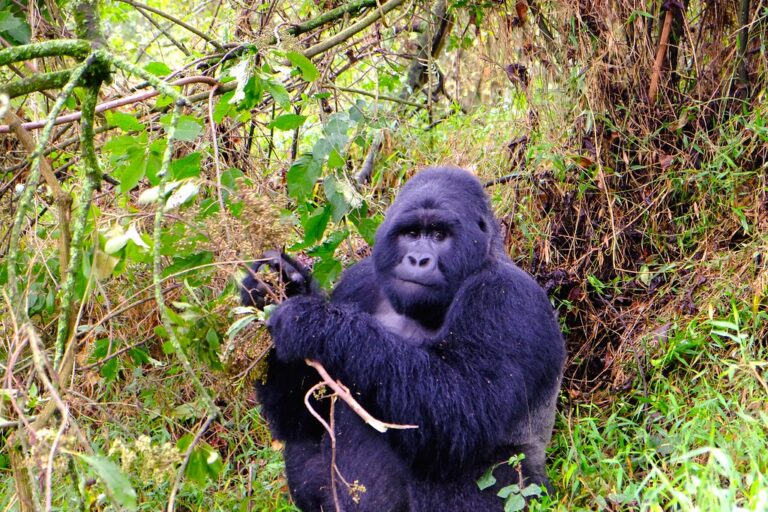
Mountain gorillas are the star attraction of Bwindi Impenetrable National Park. These powerful but highly social primates live in family groups usually associated with a dominant silverback, adult females, younger males and juveniles. Watching them interact can reveal surprisingly recognizable behaviors: mothers caring for infants, juveniles playing, adults feeding and silverbacks monitoring their surroundings.
The mountain gorilla has been one of Africa’s great conservation success stories. Its population was once dangerously low, but coordinated conservation, veterinary care, anti-poaching measures, habitat protection and carefully managed tourism have contributed to a major recovery.
Bwindi’s importance is therefore both ecological and economic. Gorilla tourism creates employment for guides, trackers, porters, lodge staff and other community members while generating revenue that supports conservation and local development.
Visitors should remember that gorillas remain wild animals. The goal of gorilla trekking is not to touch, feed or interfere with them. The best encounter is one in which the animals continue behaving naturally while visitors observe respectfully from an appropriate distance under ranger guidance.
Gorilla Trekking in Bwindi Impenetrable National Park
Gorilla trekking is the most sought-after activity in Bwindi Impenetrable National Park. A typical trek begins with a briefing at the designated trailhead before visitors enter the forest with guides and Uganda Wildlife Authority rangers.
Trackers usually go ahead of the tourist group to locate the gorilla family. The trekking group then follows information from the trackers. Because gorillas move through natural habitat, there is no guaranteed fixed trekking distance. Some groups may be found relatively close to the trailhead while others can require several hours of hiking.
Uganda Wildlife Authority states that gorilla treks can take approximately two to seven hours and include up to one hour of observation with a habituated family. Moderate fitness is therefore important.
The trek itself is part of the experience. You may walk through muddy sections, cross streams, climb steep slopes and squeeze between vegetation. Rain can make trails slippery, so appropriate clothing and footwear are essential.
When the gorillas are located, the atmosphere changes dramatically. The dense vegetation may suddenly reveal a silverback sitting quietly nearby, a mother carrying an infant or young gorillas tumbling through the vegetation. These encounters are usually the emotional high point of a Uganda gorilla safari.
Gorilla trekking should be booked well in advance, particularly for peak travel periods. Permits are limited, and your permit is linked to the designated trekking arrangements.
Gorilla Habituation Experience in Bwindi
For travelers who want a longer gorilla experience, the Gorilla Habituation Experience is an important option. Habituation involves spending substantially more time with gorillas that are undergoing the process of becoming accustomed to the presence of humans for research and future tourism purposes.
Unlike standard gorilla trekking, which provides up to one hour of observation once the gorillas are located, habituation is designed as a longer, more immersive experience. It is particularly appealing to wildlife photographers, primate enthusiasts, researchers and travelers who want to understand gorilla behavior in greater detail.
The activity is associated with the Rushaga sector of Bwindi. Because habituation involves special conservation and research considerations, travelers should confirm current availability, rules and pricing directly with Uganda Wildlife Authority or through a reputable Uganda safari operator before booking.
A habituation experience can also be physically demanding. You may spend much of the day moving through steep, wet forest while following the gorillas. It is therefore best suited to visitors who are comfortable with extended hiking.
The Four Main Bwindi Gorilla Trekking Sectors
Bwindi is commonly described through four main tourism sectors: Buhoma, Ruhija, Rushaga and Nkuringo. Each has its own atmosphere, accommodation options, access routes and gorilla families.
Buhoma is the historic northern sector and one of the best-known bases for gorilla trekking in Uganda. It has a strong tourism infrastructure and is also associated with forest walks and community experiences.
Ruhija lies on the eastern side of Bwindi and is known for its beautiful forest environment and excellent birding opportunities. It is a popular choice for travelers combining gorilla trekking with Uganda birding.
Rushaga, in southern Bwindi, is especially important for visitors interested in gorilla habituation as well as standard gorilla trekking. The area can also be combined with Lake Mutanda, Kisoro and other southwestern attractions.
Nkuringo is another southern sector, famous for steep terrain and dramatic scenery. It is often chosen by travelers who want a more secluded forest setting and spectacular views.
Sector selection matters because Bwindi is not a small, single trailhead. Book your permit for the sector where you intend to trek and choose accommodation nearby. This reduces unnecessary transfers and makes your safari much easier.
Wildlife in Bwindi Impenetrable National Park
Although gorillas are the headline attraction, Bwindi supports a remarkable range of wildlife. The forest contains numerous primate species and other mammals, although sightings are generally less predictable than wildlife encounters on an open savannah game drive.
Potential wildlife includes chimpanzees, L’Hoest’s monkeys, black-and-white colobus monkeys and other forest primates. African forest elephants are also associated with Bwindi, although they are extremely difficult to see.
The forest’s importance is particularly evident in its plant and insect diversity. UNESCO identifies Bwindi as an important habitat for numerous endemic butterflies and other species. The combination of altitude, rainfall, ancient forest and its position within the Albertine Rift has created an exceptional ecological environment.
Visitors should therefore approach Bwindi as a rainforest ecosystem rather than a traditional big-game park. The reward is not necessarily a long list of large mammals. Instead, it is the chance to experience a complex living forest where every trail can reveal something different.
Bird Watching in Bwindi
Bwindi Impenetrable National Park is one of Uganda’s premier birding destinations and an excellent choice for travelers who want to combine gorilla trekking with bird watching.
UNESCO records more than 347 bird species in the property and notes the presence of many Albertine Rift endemics. This makes Bwindi particularly valuable for specialist birders hoping to see species that are difficult or impossible to find elsewhere.
Birding is available around different forest trails and sectors, with Ruhija particularly well known among birding travelers. Species sought by birders may include African green broadbill, Grauer’s swamp warbler, Shelley’s crimson-wing and other forest birds.
The dense vegetation means birding in Bwindi can be more demanding than birding in open habitats. A knowledgeable local bird guide can make a major difference because experienced guides know calls, feeding locations and the best forest trails.
If you are combining birding with gorilla trekking, allow enough time. Trying to complete a serious birding itinerary and a gorilla trek in a single rushed visit can reduce the quality of both experiences.
Hiking and Nature Walks in Bwindi
Bwindi offers rewarding forest walks for travelers who want to explore the ecosystem beyond gorilla trekking. Nature trails can lead through thick vegetation, streams and forested slopes while offering opportunities to see birds, butterflies, primates and plant species.
Forest hiking is also a good option for travelers who are unable to secure a gorilla permit or who want an additional activity after their trek.
Popular walks and trail experiences have historically included routes around Buhoma and other sectors, including waterfall and forest trails. Trail availability can change because of conservation management, weather and local conditions, so visitors should confirm which trails are open when they arrive.
Walking with a local guide is strongly recommended. A guide can explain medicinal plants, tree species, bird calls, traditional uses of the forest and the cultural history of the surrounding communities.
For photographers, forest walks can be particularly rewarding. Mist, shafts of light, moss-covered trees, butterflies and dense foliage create atmospheric images that are very different from typical African safari photography.
Bwindi Forest and the Albertine Rift
Bwindi’s extraordinary biodiversity is closely connected to its location in the Albertine Rift, one of Africa’s most important biodiversity regions. The forest lies at the meeting point of major ecological zones and contains habitats ranging from lower-elevation forest to montane environments.
UNESCO identifies Bwindi as an important refuge for species and highlights the number of Albertine Rift endemics found there. The park’s biological richness is one reason it has such high conservation value.
For travelers, this means that a Bwindi safari is not simply about seeing one famous animal. It is a journey into an ancient and highly specialized ecosystem. The mountain gorilla is the most visible symbol of that ecosystem, but the forest’s trees, ferns, insects, birds and other mammals are equally important to its ecological story.
Batwa Cultural Experiences Around Bwindi
The forests of southwestern Uganda have long been connected to Indigenous Batwa communities. Batwa cultural experiences around Bwindi can provide visitors with an opportunity to learn about forest traditions, food, music, medicinal plants and historical relationships with the forest.
A responsible cultural visit should prioritize community-led experiences rather than treating local people as an attraction. Ask your safari operator which community projects are genuinely community managed and how tourism revenue reaches local residents.
Cultural tourism can complement gorilla trekking by showing that conservation is not isolated from human livelihoods. Communities living around protected areas have a major role in supporting long-term conservation, and tourism can create incentives for protecting natural habitats when benefits are shared fairly.
Best Time to Visit Bwindi Impenetrable National Park
Bwindi can be visited throughout the year, but travel conditions vary with rainfall. Because the park is a rainforest, rain is possible even during traditionally drier periods.
Many travelers prefer the relatively drier months because hiking conditions can be easier. However, the wetter periods can also offer advantages, including lush vegetation and fewer visitors in some periods. There is no guarantee that a particular month will be completely dry.
If your primary goal is gorilla trekking, the best time is often determined by your overall Uganda safari schedule, permit availability and preferred travel conditions rather than by trying to find a completely rain-free month.
Whatever season you choose, prepare for wet conditions. A waterproof jacket, waterproof backpack cover, sturdy hiking boots, moisture-wicking clothing and protection for cameras and phones are highly recommended.
How Difficult Is Gorilla Trekking in Bwindi?
Gorilla trekking in Bwindi can range from moderately challenging to very strenuous. The difficulty depends on the location of the gorilla family, altitude, weather, trail conditions and your own fitness.
The forest is hilly and vegetation can be dense. Some routes involve steep climbs and descents, and wet ground can become slippery. Uganda Wildlife Authority recommends moderate fitness because treks may last several hours.
You do not need to be an elite athlete to trek gorillas, but preparation helps. Walking regularly before your trip, strengthening your legs and getting used to longer hikes can make the experience much more enjoyable.
Travelers who have limited mobility should discuss their needs with a safari operator before booking. Porters are available in many trekking areas and can provide valuable practical support, including carrying daypacks and helping travelers navigate difficult terrain. Hiring a porter also provides direct economic benefits to local communities.
What to Pack for a Bwindi Gorilla Trek
Packing correctly can make a major difference during a Bwindi gorilla trek. The rainforest environment is wet, muddy and unpredictable, so prioritize practical equipment over fashion.
Essential items include sturdy waterproof hiking boots, long trousers, a long-sleeved shirt, waterproof jacket, gardening-style gloves, a small backpack, drinking water, snacks, sunscreen, insect repellent and a hat.
Neutral-colored clothing is generally preferable for wildlife viewing. Avoid strong perfumes because you are entering a natural environment where minimizing unnecessary disturbance is important.
For photography, carry a camera with enough battery power and memory. A waterproof bag or dry bag can protect electronics during sudden rain. Trekking poles can also be useful on steep or muddy trails.
Do not overpack. A small, comfortable daypack is much easier to carry through dense forest than a heavy backpack.
Where to Stay in Bwindi
Accommodation around Bwindi ranges from budget guesthouses to comfortable mid-range lodges and high-end luxury properties. The most important decision is not simply the price level; it is the location relative to your gorilla trekking sector.
If you are trekking in Buhoma, stay near Buhoma. If your permit is for Ruhija, choose accommodation around Ruhija. The same principle applies to Rushaga and Nkuringo.
Lodges can offer forest views, fireplaces, restaurants, packed lunches and other safari services. Some properties emphasize luxury and wellness, while others provide simple accommodation aimed at budget travelers.
When comparing accommodation, look at road access, distance to the trailhead, meals, electricity, hot water, Wi-Fi availability, porter arrangements and whether the lodge can help coordinate early-morning transport.
Staying close to the trekking point is particularly valuable because gorilla trekking generally starts early. A nearby lodge reduces the stress of a long morning transfer.
How to Get to Bwindi Impenetrable National Park
There are several ways to reach Bwindi. Most travelers arrive by road from Entebbe or Kampala, often combining the journey with other southwestern Uganda attractions.
A road safari allows travelers to see rural Uganda along the way and can be combined with destinations such as Lake Mburo, Queen Elizabeth National Park and Lake Bunyonyi. Depending on your route and sector, the journey from central Uganda can take much of a day.
International travelers may also consider flying into Kigali and crossing into Uganda by road, particularly when visiting southern Bwindi sectors. This can significantly reduce driving time compared with traveling from Entebbe, depending on border arrangements and the final destination.
Domestic or charter flights can also be considered for travelers prioritizing convenience. Flights require additional ground transfers, and availability depends on the relevant airstrip and safari itinerary.
Your best route depends on your gorilla sector, budget, arrival airport and the other destinations on your Uganda safari.
Bwindi and Lake Bunyonyi
Lake Bunyonyi is one of the most popular destinations to combine with Bwindi. Located near Kabale, the scenic lake is surrounded by terraced hills and numerous small islands.
A combination of Bwindi gorilla trekking and Lake Bunyonyi creates a balanced itinerary. After a demanding forest trek, travelers can relax beside the lake, take a canoe or boat trip, explore the surrounding hills or simply enjoy the scenery.
The pairing is especially attractive for travelers who want a slower cultural and scenic experience after the intensity of gorilla trekking.
Many Uganda safari itineraries combine Bwindi, Lake Bunyonyi and Queen Elizabeth National Park, creating a route that includes rainforest, lakes, savannah and classic wildlife viewing.
Bwindi and Queen Elizabeth National Park
Combining Bwindi Impenetrable National Park with Queen Elizabeth National Park creates one of Uganda’s strongest wildlife itineraries. Queen Elizabeth offers a very different environment, with savannah, wetlands, crater lakes and the famous Kazinga Channel.
Travelers can experience a game drive in Queen Elizabeth National Park before or after trekking gorillas in Bwindi. Depending on the itinerary, the Ishasha sector may also be included, particularly for travelers interested in tree-climbing lions.
The contrast between the two parks is part of the attraction. Queen Elizabeth provides classic African safari landscapes, while Bwindi delivers an intimate rainforest and primate experience.
A well-designed itinerary should allow sufficient time in each destination rather than treating Bwindi as a rushed stopover.
Bwindi Conservation and Responsible Tourism
Conservation is at the heart of the Bwindi experience. Protecting mountain gorillas and their forest habitat requires funding, research, veterinary support, law enforcement and cooperation with surrounding communities.
Tourism can contribute to this system by generating employment and conservation revenue. Recent reporting has highlighted how gorilla tourism in Uganda has helped support conservation and local livelihoods.
Visitors also have responsibilities. Follow ranger instructions, do not touch or feed gorillas, avoid visiting when sick, maintain the required distance and minimize noise. These measures reduce stress and the risk of disease transmission.
Responsible tourism also means choosing accommodation and tour operators that respect local communities and environmental standards. Hiring local porters and purchasing legitimate local crafts or services can help spread tourism benefits.
The future of Bwindi depends on maintaining a workable balance between tourism, conservation and the needs of communities surrounding the forest.
Bwindi Impenetrable National Park vs Mgahinga Gorilla National Park
Uganda offers two places for mountain gorilla trekking: Bwindi Impenetrable National Park and Mgahinga Gorilla National Park. Bwindi is the larger and more established gorilla destination, with several trekking sectors and a wide range of accommodation.
Mgahinga is part of the Virunga volcanic landscape and offers a different setting, with dramatic mountain scenery. It is a good alternative for travelers who want a smaller, more volcanic environment.
Bwindi is generally the stronger choice for travelers who want more sector options, birding opportunities and a broad rainforest experience. Mgahinga can be ideal for travelers interested in volcanoes and the Virunga landscape.
The best choice depends on permit availability, route, accommodation and the wider safari itinerary.
Top Reasons to Visit Bwindi Impenetrable National Park
There are many reasons to put Bwindi on a Uganda safari itinerary.
First, it provides one of the world’s most remarkable wildlife encounters: observing mountain gorillas in their natural habitat.
Second, the park is a globally recognized biodiversity hotspot and UNESCO World Heritage Site.
Third, Bwindi offers more than gorillas. Birding, forest walks, butterflies, primates and cultural experiences can extend the safari.
Fourth, the forest provides a powerful contrast to Uganda’s savannah parks. Travelers who have already visited Murchison Falls, Queen Elizabeth or Kidepo will experience a completely different ecosystem.
Fifth, responsible gorilla tourism can contribute to conservation and community livelihoods, making the trip meaningful beyond sightseeing.
Finally, Bwindi is one of those destinations where the journey itself becomes part of the memory. The misty mountains, winding roads, forest trails and local communities create an atmosphere that cannot be reproduced by a standard game drive.
How Many Days Do You Need in Bwindi?
A minimum of two nights around Bwindi is generally sensible for travelers doing gorilla trekking. This provides time to arrive, rest and complete the trek without trying to squeeze the entire experience into a rushed schedule.
Three nights can be even better if you want to add birding, a forest walk, cultural experience or a second major activity.
For a broader Uganda safari, Bwindi can be incorporated into itineraries lasting from around 5 days to two weeks or more. A short itinerary could focus on gorillas and Lake Bunyonyi, while a longer route could include Kibale chimpanzee trekking, Queen Elizabeth game drives, Murchison Falls or Kidepo Valley National Park.
Your ideal number of days depends on whether gorilla trekking is the main purpose of your trip or one component of a larger Uganda safari.
Planning a Uganda Gorilla Safari to Bwindi
Planning a successful Bwindi gorilla safari begins with choosing the trekking sector and travel dates. Once those are established, secure the gorilla permit and build the accommodation and transport around the permit location.
Next, decide whether you want standard gorilla trekking or a longer habituation experience. Add other activities based on your interests, such as birding, forest walks, cultural tourism and photography.
Travelers should also plan for changing weather and challenging terrain. Give yourself enough time to rest before the trek, especially if you have arrived after a long international flight.
A professional Uganda safari operator can coordinate permits, transport, accommodation, guides and border or airport logistics. When selecting a company, look for clear pricing, responsive communication, experience in Bwindi and transparent permit arrangements.
Avoid building an itinerary that spends most of its time on the road. The best Uganda safari is not necessarily the one with the most destinations; it is the one that gives you enough time to experience each place properly.
Frequently Asked Questions About Bwindi Impenetrable National Park
Is Bwindi Impenetrable National Park worth visiting?
Yes. Bwindi is one of Uganda’s most distinctive destinations, especially for travelers interested in mountain gorillas, rainforest biodiversity and responsible wildlife tourism.
What is Bwindi National Park famous for?
Bwindi is most famous for its mountain gorillas and exceptional rainforest biodiversity. It is a UNESCO World Heritage Site.
Where is Bwindi located?
Bwindi is in southwestern Uganda in the Albertine Rift region, near the borders with Rwanda and the Democratic Republic of Congo.
Can you see gorillas in Bwindi?
Yes. Bwindi is one of the world’s principal destinations for observing habituated mountain gorilla families in the wild.
How long does gorilla trekking in Bwindi take?
Uganda Wildlife Authority states that gorilla treks can last approximately two to seven hours, depending on conditions and the location of the gorilla family, with up to one hour of observation.
Is Bwindi difficult to hike?
It can be challenging because the terrain is steep, wet and densely forested. Moderate fitness is recommended.
What should I wear for Bwindi gorilla trekking?
Wear sturdy hiking boots, long trousers, long sleeves and rain protection. Gloves can help protect your hands from vegetation.
Can I combine Bwindi with other Uganda safari destinations?
Yes. Popular combinations include Queen Elizabeth National Park, Lake Bunyonyi, Kibale Forest National Park and Mgahinga Gorilla National Park.
When should I book my gorilla trek?
Book as early as practical because permits are limited and preferred dates and sectors can fill up.
Is Bwindi good for bird watching?
Yes. Bwindi is one of Uganda’s important forest birding destinations and contains many Albertine Rift bird species.
Final Thoughts: Why Bwindi Belongs on Your Uganda Safari
Bwindi Impenetrable National Park is far more than a place to see gorillas. It is an ancient rainforest, a UNESCO World Heritage Site, a biodiversity sanctuary and a vital conservation landscape.
For travelers, the defining experience is gorilla trekking: hiking into dense forest, following expert trackers and finally sitting quietly near a mountain gorilla family. Few wildlife encounters are as intimate or as memorable.
But Bwindi also rewards travelers who slow down. Birders can search for Albertine Rift endemics. Hikers can explore forest trails. Photographers can capture misty mountains and lush vegetation. Cultural travelers can learn from communities around the forest. And safari enthusiasts can combine the park with Uganda’s savannah reserves and scenic lakes.
If you are planning a Uganda safari, make Bwindi a central part of your itinerary rather than simply adding it as an overnight stop. Choose the right trekking sector, secure your permit early, stay close to the trailhead and prepare properly for a challenging but rewarding rainforest hike.
Bwindi Impenetrable National Park represents one of Uganda’s greatest natural treasures. A visit here is not simply a holiday activity; it is an opportunity to experience one of Africa’s most remarkable ecosystems while contributing, through responsible tourism, to the continued protection of mountain gorillas and their forest home.