
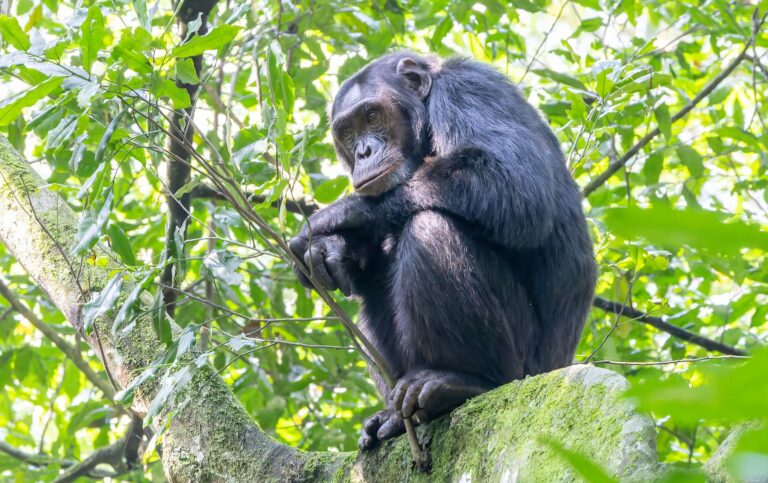
Welcome to the ultimate authority guide for Kibale National Park, globally celebrated as the Primate Capital of the World. Spanning 795 square kilometers (307 square miles) of pristine tropical rainforest, semi-deciduous woodlands, and vibrant wetland ecosystems in Western Uganda, Kibale represents Africa’s single most ecologically rich primate haven. This guide provides comprehensive, high-conversion, and SEO-optimized insights into chimpanzee trekking, habituation permits, luxury eco-lodges, transport logistics, and multi-day safari circuits.
Key Highlight: Kibale Forest National Park harbors over 1,500 chimpanzees, representing Uganda’s highest density of primates. With a chimpanzee tracking success rate exceeding 98%, it offers unmatched wildlife viewing standard across East Africa. |
1. Comprehensive Overview & Biodiversity
Situated at an elevation ranging between 1,100 meters (3,600 ft) and 1,590 meters (5,220 ft) above sea level, Kibale National Park forms a continuous ecological corridor with Queen Elizabeth National Park. This unique geographic position enables an exceptional blend of montane and lowland flora and fauna, serving as a critical bridge between the dry savannas of East Africa and the dense, humid rainforests of the Congo Basin.
The 13 Primate Species of Kibale Forest
- Eastern Chimpanzee (Pan troglodytes schweinfurthii): Over 1,500 habituated and wild individuals roaming the dense canopy.
- Uganda Red Colobus (Piliocolobus tephrosceles): An endangered species thriving in Kibale’s upper canopy layers.
- L’Hoest’s Monkey (Cercopithecus lhoesti): Vulnerable, ground-dwelling primates frequently encountered along forest trails.
- Black-and-White Colobus (Colobus guereza): Readily identified by their striking long white tails and mantles.
- Ugandan Grey-cheeked Mangabey (Lophocebus ugandae): An endemic arboreal species known for loud, booming calls.
- Red-tailed Monkey (Cercopithecus ascanius): Playful and agile canopy dwellers with distinctive heart-shaped nose spots.
- Blue Monkey (Cercopithecus mitis): Deep forest primates inhabiting high, dense foliage.
- Olive Baboon (Papio anubis): Commonly seen along forest perimeters and road crossings.
- Nocturnal Primates: Includes Thomas’s Galago, Demidoff’s Galago, Spectacled Galago, and the Central African Potto.
Beyond primates, Kibale National Park safeguards over 375 documented bird species, 70 mammal species—including forest elephants, bush pigs, sitatungas, and buffaloes—and more than 250 species of colorful tropical butterflies.
2. Chimpanzee Trekking: Permits, Guidelines & Rules
Chimpanzee trekking is the flagship safari adventure in Kibale. Managed under strict conservation protocols by the Uganda Wildlife Authority (UWA), the trekking operations originate primarily at the Kanyanchu Visitors Centre.
Standard Chimpanzee Trekking Details
- Departure Point: Kanyanchu Visitors Centre.
• Daily Shift Times: Morning session (Briefing at 7:30 AM, starts 8:00 AM) and Afternoon session (Briefing at 1:30 PM, starts 2:00 PM).
• Trek Duration: 2 to 4 hours depending on chimpanzee movement and nesting positions.
• Observation Time: Strictly 1 hour upon locating the troop to prevent distress.
• Group Size Limits: Maximum 6 trekkers per ranger-guided group.
Chimpanzee Habituation Experience (CHEX)
For avid wildlife photographers, researchers, and immersive safari seekers, UWA offers the Chimpanzee Habituation Experience (CHEX). Unlike standard trekking, CHEX permits visitors to accompany wildlife researchers and trackers during the habituation process. Guests spend either a full day or half day following a semi-habituated community from nest-break at dawn to nest-building at dusk.
Essential Trekking Rules & Health Regulations
- Age Limit: Trekkers must be at least 12 years of age (recently revised from 15 by UWA).
- Safe Distance: Maintain a mandatory distance of at least 8 meters (25 feet) at all times.
- Health Control: Visitors with communicable illnesses (flu, cold, fever, COVID-19) are prohibited, as chimps share ~98.8% human DNA.
- Photography Restrictions: Flash photography is strictly forbidden as it provokes aggressive behavior.
- Environmental Protection: No littering, eating, or drinking within 8 meters of the primates.
3. Official 2026/2027 Permit Tariffs & Cost Breakdown
Below is the official breakdown of fees for activities in Kibale National Park, issued by the Uganda Wildlife Authority (UWA) and local community conservation trusts:
| Activity / Fee Category | Rates (FNR / FR / EAC) |
| Chimpanzee Trekking Permit | $250 USD / $200 USD / UGX 150,000 |
| Chimpanzee Habituation (CHEX) | $300 USD / $250 USD / UGX 250,000 |
| Park Entry Fee (Adults/24h) | $40 USD / $30 USD / UGX 20,000 |
| Bigodi Wetland Community Walk | $20 USD / $20 USD / UGX 30,000 |
| Guided Forest Nature Walk | $30 USD / $15 USD / UGX 10,000 |
| Night Nature Walk (Nocturnal) | $40 USD / $20 USD / UGX 15,000 |
4. Top Eco-Tourism Activities Around Kibale Forest
A. Bigodi Wetland Sanctuary Walk
Located 6 kilometers south of Kanyanchu, Bigodi Wetland Sanctuary in Magombe Swamp is an award-winning community-run conservation enterprise operated by KAFRED (Kibale Association for Rural and Environmental Development). The 2-to-3-hour guided boardwalk walk reveals 8 primate species, sitatunga antelopes, and over 200 bird species, most notably the magnificent Great Blue Turaco.
B. Ndali-Kasenda Crater Lakes Exploration
Formed by volcanic activity thousands of years ago, the picturesque Ndali-Kasenda field boasts over 50 deep crater lakes framed by tea plantations and steep forest rims. Visitors enjoy hiking to the ‘Top of the World’ viewpoint, mountain biking, and canoeing across volcanic lakes such as Nyabikere, Nkuruba, and Kifuruka.
C. World-Class Bird Watching
Designated as an Important Bird Area (IBA), Kibale protects key avian specialties including the Green-breasted Pitta, African Grey Parrot, Afep Pigeon, Black-capped Apalis, Blue-headed Sunbird, and Purple-breasted Sunbird.
5. Best Time to Visit & Where to Stay
Kibale Forest is accessible year-round, but distinct weather patterns dictate hiking conditions and primate visibility:
Seasonal Guide: • Peak Dry Seasons (June – September & December – February): Best trail conditions, lower humidity, clear skies. Advance permit booking (3-6 months) essential. |
Recommended Lodges & Safari Camps
- Luxury Tier ($400 – $900+ / night): Kyaninga Lodge (log-cabin luxury on crater lake), Ndali Lodge, Primate Lodge Kibale (located directly inside park grounds), Papaya Lake Lodge.
- Mid-Range Tier ($150 – $350 / night): Turaco Treetops (modern canopy views & pool), Isunga Lodge, Chimpanzee Forest Eco-Lodge.
- Budget Tier ($30 – $120 / night): Kibale Forest Camp, Rweteera Safari Park, Ruwenzori View Guesthouse.
6. Ultimate Uganda Safari Itineraries Featuring Kibale
- 3-Day Kibale Chimpanzee Trekking Express: Designed for quick weekend breaks. Day 1: Kampala to Fort Portal & crater walk. Day 2: Morning Chimp Trek & afternoon Bigodi Swamp. Day 3: Scenic return drive via the Equator.
- 7-Day Uganda Primates & Wildlife Safari: Combines chimps, gorillas, and savanna game. Day 1-2: Kibale Chimp Trek & Bigodi. Day 3-4: Queen Elizabeth NP game drives & Kazinga boat cruise. Day 5-7: Bwindi Gorilla Trekking & Lake Bunyonyi.
- 10-Day Grand Uganda Safari Circuit: Entebbe -> Ziwa Rhinos -> Murchison Falls -> Kibale Forest CHEX Experience -> Queen Elizabeth NP -> Bwindi Impenetrable Forest -> Lake Mburo NP -> Departure.
Book Your Custom Safari with Ostafrikareisen
At Ostafrikareisen, we specialize in tailor-made, sustainable, and unforgettable safari experiences across Uganda, Kenya, Tanzania, and Rwanda. Our team arranges official UWA chimpanzee and gorilla permits, private 4×4 Land Cruiser transport, expert multi-lingual guides, and hand-picked eco-lodges. Contact our specialists today at https://ostafrikareisen.com/ to craft your customized East African adventure.